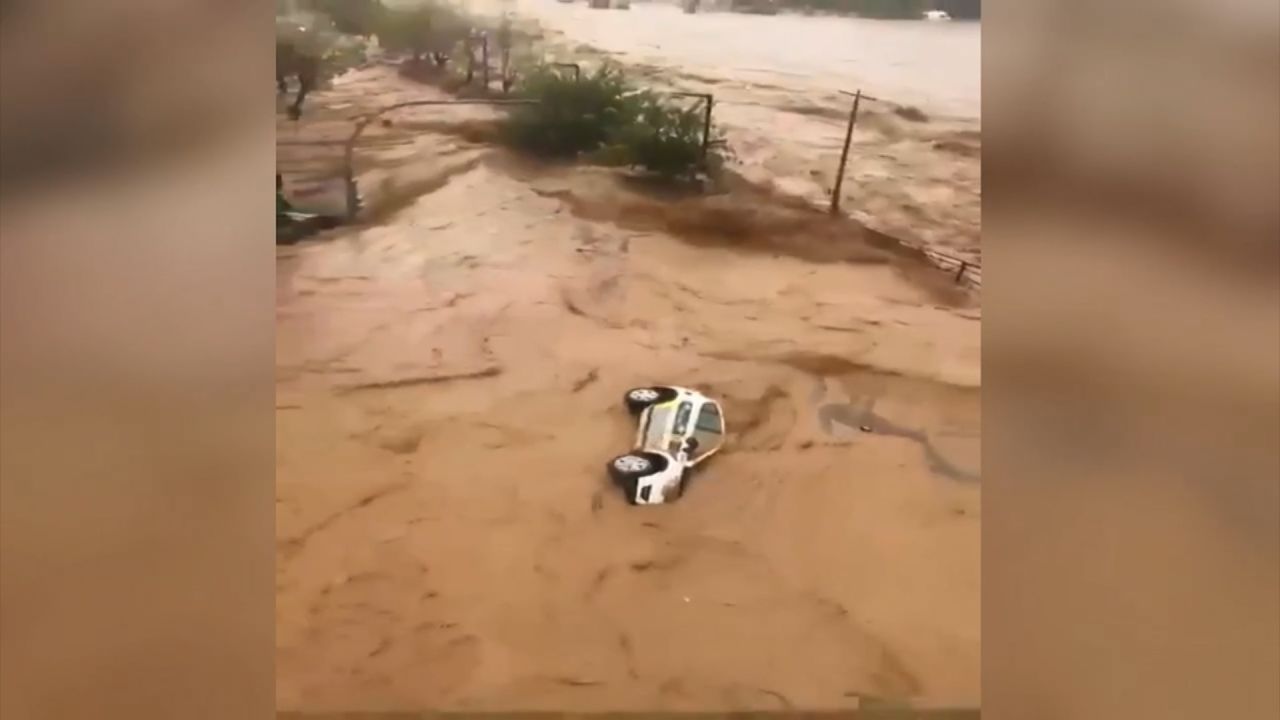
The sky over Valencia didn’t just turn gray; it turned into a literal ocean suspended in the air. Honestly, if you saw the footage from late 2024, you know it looked less like a storm and more like a biblical event. This is the reality of flash flooding in Spain right now. It isn't just "unfortunate weather" anymore. It’s a systemic, recurring crisis that catches even the most prepared locals off guard.
Water moves differently in the Mediterranean. It’s aggressive.
You’ve probably heard of the DANA (Depresión Aislada en Niveles Altos). Meteorologists talk about it constantly, but basically, it's a pocket of cold air that gets "cut off" from the main jet stream. When that cold air hits the warm, humid air rising off the Mediterranean Sea, the result is explosive. We aren't talking about a rainy afternoon. We're talking about a year's worth of rain falling in eight hours. That is exactly what happened in places like Chiva and Paiporta, where the landscape was fundamentally altered in a single night.
The DANA Effect: It’s not your average thunderstorm
Most people think of floods as rising rivers. That’s not what we’re dealing with here. Flash flooding in Spain is often caused by these "cold drops" that stay stationary over a specific town for hours. Because the Mediterranean has been hitting record-high temperatures—sometimes reaching over 28°C—the air is packed with moisture. It’s like a giant sponge being squeezed over a tiny area.
The geography of the Spanish coast makes it so much worse. You have high mountains very close to the sea. When the rain hits those slopes, it doesn't soak in. It gathers speed. It turns into a wall of mud, cars, and debris that hits the coastal plains with the force of a freight train. Experts like Dr. José María Bodoque from the University of Castilla-La Mancha have spent years studying how these "flashy" catchments respond. The time between the rain falling and the peak flood can be minutes. Just minutes.
It’s terrifyingly fast.
Why the infrastructure is struggling to keep up
Look, Spain is actually very good at water management. We have some of the best dams and diversion channels in the world. The Turia River diversion in Valencia, built after the catastrophic 1957 flood, saved the city center from total destruction in 2024.
But there is a catch.
Urban sprawl has been relentless. Over the last forty years, developers built shopping centers and housing estates right on top of "ramblas." These are dry riverbeds that stay empty for 360 days a year. People forget they are actually drains. When the DANA hits, the water follows its ancient path. It doesn't care that there’s a parking lot there now.
Concrete and the "Seal" Effect
When you cover the ground in asphalt, the water has nowhere to go. In a natural field, the soil absorbs a decent chunk of rain. In a city? Zero. The runoff coefficient—basically a measure of how much rain stays on the surface—skyrockets. This creates a "tsunami" effect in urban streets. You’ll see videos of cars being tossed around like toys. That’s not just because of the volume of water; it’s the velocity.
The role of climate change is no longer "theoretical"
We can’t talk about flash flooding in Spain without acknowledging that the Mediterranean is basically a gas tank for storms. Research from the State Meteorological Agency (AEMET) shows that while the total annual rainfall in Spain might be decreasing, the intensity of individual events is going up.
It’s a paradox.
Spain is getting drier, which makes the soil hard and "hydrophobic." Then, when a massive storm hits, the parched earth acts like concrete. It rejects the water. This creates a lethal cycle of drought followed by devastating floods. The 2024 Valencia disaster wasn't an outlier; it was a blueprint for the future.
What most people get wrong about flood warnings
There’s a lot of finger-pointing after these events. "Why didn't the phone alerts go off sooner?" "Why were people still driving to work?"
The truth is complicated.
Predicting exactly which village will be underwater is incredibly hard. A DANA can shift ten miles to the left, and one town gets a light drizzle while the next gets decimated. This uncertainty leads to "warning fatigue." If the government sends out an alert and nothing happens, people stop listening. Then, when the real one comes, they’re caught in their cars.
And that is where most deaths occur. In cars.
People think they can drive through six inches of water. They can't. Your car will lose traction, and suddenly you are in a floating metal coffin. The force exerted by moving water is exponential. If the water reaches your knees and it’s moving fast, you’re likely going down.
Survival and adaptation: What to actually do
If you live in or are visiting an area prone to flash flooding in Spain, you need a different mindset.
First, ignore the "it’s just rain" crowd. If AEMET issues a Red Alert (Aviso Rojo), it means there is a "probabilistic risk to life." It’s not a suggestion to bring an umbrella. It’s a suggestion to stay on the second floor of a building.
Real-world steps for flood safety
- Check the "Ramblas": If you’re buying or renting a property, look at the topography. Is the house at the bottom of a slope? Is there a dry ditch nearby? If so, that ditch is a river in waiting.
- The 30-centimeter rule: Never, ever drive into water. If you can't see the pavement, don't go. If your car stalls in rising water, get out immediately and move to higher ground. Do not wait for a tow truck.
- Vertical Evacuation: In a flash flood, you don't run away. You go up. The pressure of the water can lock your front door shut, so you need to be on an upper floor before the water hits the street level.
- Digital Tools: Use the Rain Alarm app or follow AEMET’s live radar. Don't wait for the news at 8 PM. Look at the radar. If you see a stationary purple or "white" blob over your area, the situation is critical.
Moving forward in a wetter, hotter Spain
We are seeing a shift in how Spanish cities are being redesigned. There’s a move toward "Sponge Cities." This involves using permeable pavements and "floodable parks" that are designed to hold water during a storm and release it slowly later. It’s a smart move, but it’s expensive and slow to implement.
The reality of flash flooding in Spain is that we are living in a new climate era. The old maps don't always work. The old "once-in-a-hundred-years" stats are being rewritten every decade.
It takes a mix of high-tech meteorology and old-school common sense to stay safe. Respect the water. It’s been carving these landscapes for millions of years, and it isn't going to stop for a housing development or a morning commute.
Actionable Insights for Residents and Travelers
- Monitor AEMET daily: During the autumn months (September to November), check the weather alerts every single morning. This is the peak window for the Gota Fría.
- Emergency Kit: Keep a bag with your ID, essential meds, and a power bank in a high spot in your house. If you have to move to the roof, you’ll need these.
- Insurance Check: Ensure your insurance covers "Consorcio de Compensación de Seguros." In Spain, this is the body that handles extraordinary risks like floods. Without it, you could lose everything with no recourse.
- Local Knowledge: Talk to the older generation in the village. They remember where the water went in 1982 or 1957. That collective memory is often more accurate than a developer's brochure.
Stay vigilant. The Mediterranean is beautiful, but when the conditions are right, it is a powerhouse that demands absolute respect.