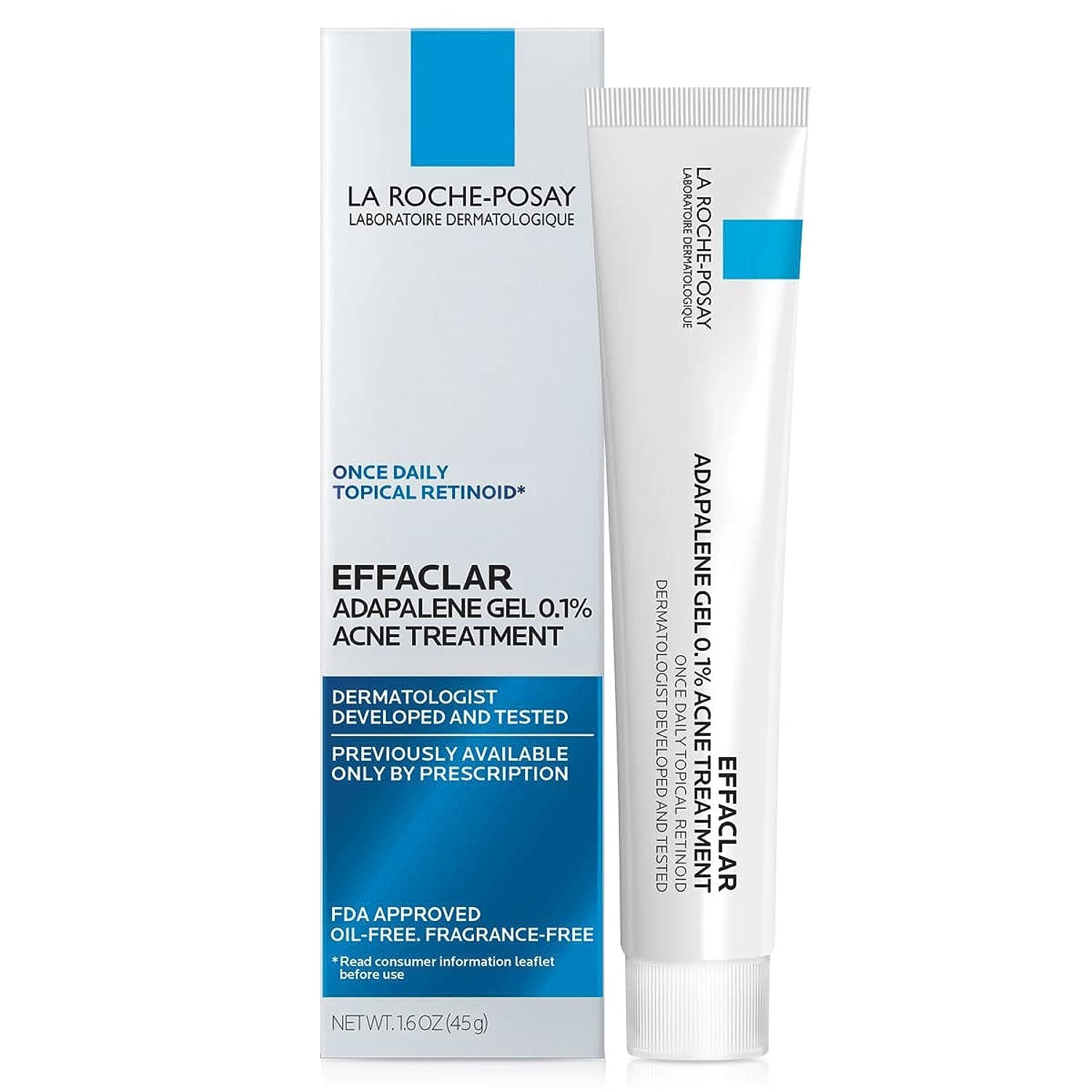
Acne is a liar. It makes you feel like your face is the only thing people see when you walk into a room, which, honestly, is rarely true, but try telling that to someone staring at a cystic breakout in a 10x magnifying mirror. You’ve probably seen the blue-and-white tube. It’s everywhere. It’s the La Roche Posay acne cream—specifically the Effaclar Duo—that everyone from your favorite TikTok derm to your cousin claims is a "miracle."
But is it?
Look, La Roche-Posay isn't some fly-by-night brand launched by an influencer in a Calabasas living room. They are owned by L'Oréal and rooted in a French town that has literally been famous for its thermal spring water since the 14th century. That's a lot of history for a tube of goo. Still, if you slather this stuff on without understanding the chemistry, you’re basically playing Russian roulette with your skin barrier. Some people wake up with clear pores; others wake up with a red, peeling mess that feels like a mild sunburn.
The reality is that "acne cream" is a broad term. When people talk about this specific brand, they’re usually referring to Effaclar Duo(+) or the Dual Action Acne Treatment. The European version and the US version are actually different products, which is a weird quirk of global drug regulations that leaves a lot of people confused. In the US, the star of the show is micronized Benzoyl Peroxide. In Europe and other markets, they lean harder on Salicylic Acid and a proprietary ingredient called Procerad.
The Chemistry of Why La Roche Posay Acne Cream Works
Let’s get into the weeds. Most acne treatments fail because they’re too aggressive or too weak. La Roche-Posay tries to hit the "Goldilocks" zone.
The US version of the La Roche Posay acne cream uses 5.5% micronized Benzoyl Peroxide (BPO). If you’ve ever used BPO before, you know it can be a nightmare—it bleaches your towels, it dries you out, and it can sting like crazy. The "micronized" part is key here. By shrinking the particles, the medication can actually get inside the pore to kill C. acnes bacteria rather than just sitting on top of your skin causing irritation. It’s paired with Lipo Hydroxy Acid (LHA). Think of LHA as Salicylic Acid’s more chill, sophisticated cousin. It exfoliates cell by cell, which is way less traumatic for sensitive skin than a high-percentage chemical peel.
Then there’s the glycerin. It’s a humectant. It’s boring. It’s also the reason your face doesn't fall off. By including hydrating elements, the formula tries to counteract the dehydrating effects of the BPO.
But here is the thing people get wrong: they use it like a moisturizer. Don’t do that. Even though the texture feels like a light lotion, it is a treatment. If you apply a thick layer over your entire face twice a day right out of the gate, you are going to regret it. Your skin needs to acclimate. Honestly, starting every other night is the smartest move for the first two weeks.
The Global Confusion: US vs. Europe
If you’re scrolling through Reddit’s r/SkincareAddiction, you’ll see people arguing about whether this cream is "holy grail" or "trash." A lot of that comes down to which version they bought.
- The US Version (Dual Action): This is a drug. It contains Benzoyl Peroxide. It is designed for inflammatory acne—the red, angry bumps that hurt. It kills bacteria.
- The European Version (Effaclar Duo+M): This is a cosmetic treatment. No Benzoyl Peroxide. Instead, it uses Phylobioma active, which targets the microbiome, and Niacinamide to soothe. This version is much better for people with "maskne" or tiny whiteheads and blackheads.
If you have sensitive skin that turns red if you even look at a harsh chemical, the US version might be too much for you. On the flip side, if you have deep, bacterial acne, the European version might feel like you're bringing a toothpick to a swordfight. Know what you're buying. Check the active ingredients on the back of the box. If it says "Benzoyl Peroxide," get your white towels out because it will bleach your colored ones.
The Purge Is Real (And It Sucks)
We need to talk about "purging." It sounds like a horror movie plot, and for your skin, it kind of is. When you start using a La Roche Posay acne cream that contains LHA or BPO, it speeds up cell turnover. This means all the gunk that was sitting deep in your pores gets fast-tracked to the surface.
You might break out worse for the first 14 to 21 days. This is the "valley of despair" where most people quit and throw the tube in the trash. They think the product is breaking them out. Usually, it’s just cleaning house. However, there’s a difference between a purge and a reaction.
- Purge: Breakouts happen in areas where you usually get acne. They go away faster than normal.
- Reaction: You get tiny red bumps in places you never break out. Your skin feels itchy or hot.
If you're reacting, stop. If you're purging, hold the line.
How to Layer It Without Burning Your Face Off
I’ve seen people use this cream in some wild ways. The most common mistake? Using it with other "actives." If you are using a 10% Vitamin C serum, a Retinol, and then slapping on the La Roche Posay treatment, your skin is going to scream. You are effectively stripping your acid mantle.
The "Sandwich Method" is your best friend if you have dry skin. Apply a very thin layer of a basic moisturizer (like the Toleriane Double Repair), wait five minutes, apply a pea-sized amount of the La Roche Posay acne cream only to problem areas, and then follow up with another light layer of moisturizer. This creates a buffer. It doesn't make the medication less effective; it just makes the delivery system more manageable for your skin cells.
Also, sunscreen. This isn't a suggestion. Benzoyl Peroxide and LHA make your skin more photosensitive. If you use this cream and then go for a walk in the sun without SPF 30+, you are trading your acne for dark spots and premature wrinkles. It’s a bad trade. Don't do it.
The Hidden Costs: Beyond the Price Tag
At roughly $22 to $30 USD depending on where you shop, it’s not "cheap" for a drugstore product, but it’s cheaper than a visit to the dermatologist. But the real cost is the time it takes to see results. We live in an era of instant gratification. We want the pimple gone by tomorrow morning.
This cream doesn't work that way. Clinical studies provided by the brand suggest that you start seeing a reduction in "clogged pores" in about 3 days, but for "total acne reduction," you’re looking at a 4-to-12-week commitment. Most people don't have that kind of patience. They use it for five days, don't see a "glow up," and move on to the next thing. Consistency is boring, but it’s the only thing that actually clears skin.
Common Misconceptions and Myth Busting
- "It's a spot treatment." Actually, the brand often recommends applying it to the entire affected area (like the whole chin or forehead) to prevent new pimples from forming. Using it only on a visible bump is reactive. Using it on the "zone" is proactive.
- "More is better." No. Using a glob the size of a grape won't heal your skin faster. It will just cause chemical burns. A pea-sized amount is literally enough for your entire face.
- "It works for cystic acne." This is a tough one. If you have deep, hormonal, cystic acne that feels like hard knots under the skin, a topical cream—even a good one like this—is rarely enough. You likely need internal intervention from a doctor, like spironolactone or isotretinoin. This cream is great for surface-level inflammatory acne and comedones. It isn't a magic wand for hormonal imbalances.
Is It Worth the Hype?
Honestly? Yes, for the right person. If you have oily or combination skin and you're struggling with "standard" breakouts, the La Roche Posay acne cream is one of the most well-researched options you can buy without a prescription. It's formulated by people who actually understand the skin barrier.
But if you have extremely dry skin, or if you have eczema, stay away. The Benzoyl Peroxide will be too harsh. You’d be better off with their Effaclar Medicated Gel Cleanser, which rinses off, rather than a leave-on treatment.
Actionable Steps for Success
Stop guessing and start being methodical. If you're going to try this, do it right.
- Patch Test: Apply a tiny amount behind your ear or on your jawline for two nights. If you don't swell up or itch, you're good to go.
- The "Slow Start": Apply once every two days for the first week. Only move to every night if your skin isn't peeling.
- Ditch the Scrubs: While using this, stop using physical exfoliants (those walnut scrubs or abrasive pads). The cream is doing the exfoliating for you. Double-dipping will cause irritation.
- Hydrate: Switch to a "basic" cleanser like the La Roche-Posay Toleriane Hydrating Gentle Cleanser. You want your wash to be the "boring" part so your treatment can be the "active" part.
- Track with Photos: Take a photo in the same light every Sunday. You won't notice the change day-to-day, but at week four, the photos won't lie.
The journey to clear skin is rarely a straight line. It's more like a zig-zag of "oh, it's working" and "why did I wake up with this?" But with a stable, scientifically backed product like this, at least you’re working with a tool that has some actual weight behind it. Just remember: it's a treatment, not a miracle. Treat your skin barrier with respect, and it’ll eventually stop fighting back.