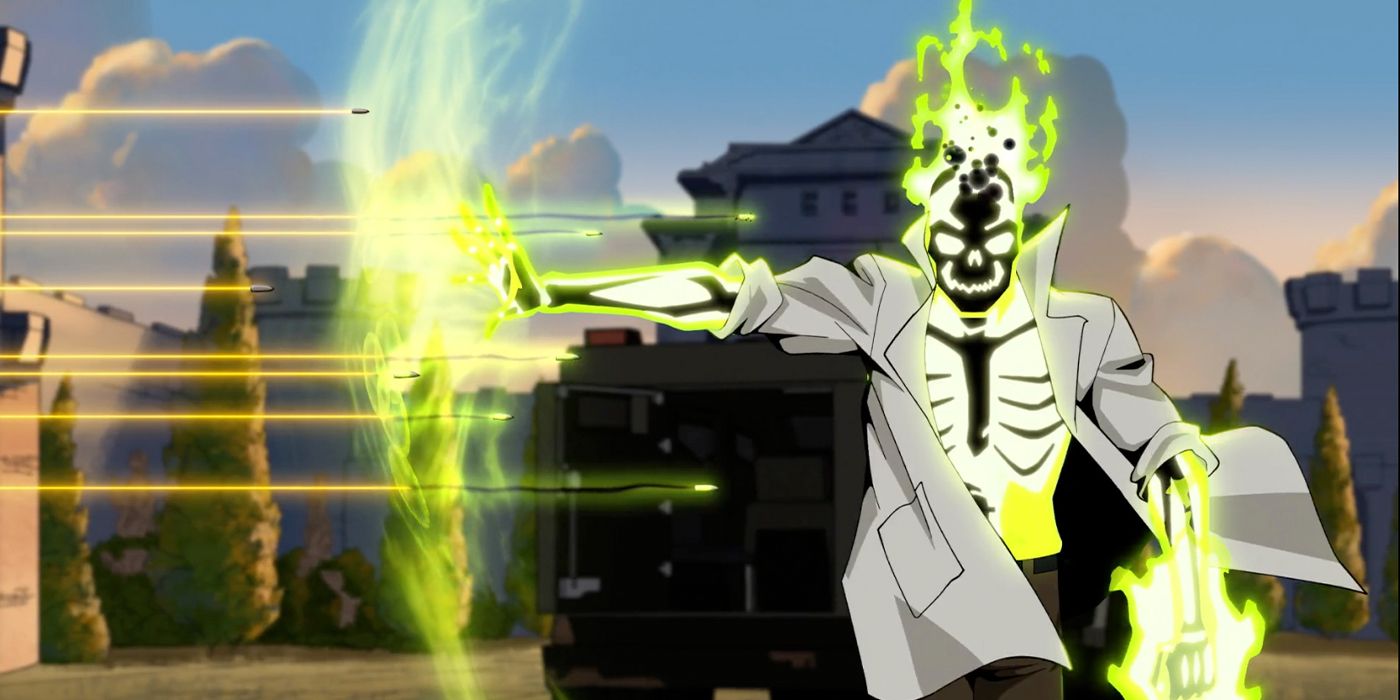
Alexander Sartorius is a nightmare. Honestly, if you grew up watching the DC Animated Universe (DCAU), you probably remember the neon-green glow of Blight, but the comic book history of Dr. Phosphorus in Batman Beyond is a whole different level of body horror. Most people think of him as a second-tier Batman rogue. A budget Scarecrow or a radioactive mistake. But when the Batman Beyond comic run brought him back into Neo-Gotham, things got weird.
He isn't just a guy who glows. He’s a walking chemical reaction.
What Really Happened with Dr. Phosphorus in Batman Beyond
In the 2011 Batman Beyond comic series—specifically the "Industrial Revolution" arc—we get to see what happened to the old guard. Most of Bruce Wayne’s enemies are dead, retired, or rotting in Arkham. Not Sartorius. Phosphorus survived into the future because his body isn't exactly biological anymore. He's a literal skeleton trapped in a shifting cloud of burning white phosphorus.
He’s basically a perpetual-motion machine of agony.
While the show focused heavily on Derek Powers (Blight), the comics decided to remind us that Dr. Phosphorus was the original radioactive threat. In this timeline, he's even more unstable. The character made a massive impact because he wasn't just there to punch Terry McGinnis; he was a bridge to Bruce Wayne's past. He represents the era of the "Old Batman" bleeding into the high-tech neon world of the 2040s.
The Blight Comparison
People mix them up. It’s easy to see why. Both are glowing skeletons, right? But the nuance matters. Derek Powers is a corporate shark who became a monster. Dr. Phosphorus in Batman Beyond is a man who was already a monster and just refused to go out. While Blight uses a skin-like suit to hide his appearance, Phosphorus is usually just out there, burning everything he touches.
In the "Industrial Revolution" storyline written by Adam Beechen, Sartorius is recruited by a villain named Matter Master. It’s a messy, high-stakes situation. Phosphorus is used as a tool, a living battery of sorts, to help cause chaos in Neo-Gotham. It highlights a recurring theme in the Beyond universe: the old villains are much more dangerous because they have nothing left to lose.
The Science of the Glow (Sorta)
Phosphorus is nasty stuff. In the real world, white phosphorus is used in incendiary weapons because it ignites on contact with oxygen and stays burning at over 800 degrees. It's incredibly difficult to put out. Now, imagine that as a person.
The DCAU version of the character leans into the tragedy of this. He can't touch anyone. He can't sit down. He can't even sleep without the floor melting beneath him. When Terry McGinnis faces off against him, he isn't just fighting a guy with powers. He’s fighting a walking environmental disaster. Terry has to rely on the suit’s heat shielding, but even that has limits.
The Batman Beyond suit is tough. It's state-of-the-art. But 800 degrees of constant thermal output will fry circuits.
Why He Sticks in Our Heads
There is a specific kind of dread that comes with Dr. Phosphorus. Unlike the Joker, who is psychological, or Bane, who is physical, Phosphorus is elemental. You can't breathe near him. You can't stand in the same room.
I think the reason he works so well in the Batman Beyond setting is the contrast. Neo-Gotham is all sleek metal, flying cars, and digital interfaces. Then you drop in this ancient, burning skeleton from the 1970s (his first appearance was Detective Comics #469). It feels wrong. It feels like a ghost has entered a computer.
- He represents the biological cost of the industrial age.
- He is a direct link to Bruce’s failure to "fix" Gotham’s corruption.
- His power set is a hard counter to Terry's gadgets.
The Fact Most Fans Miss
Here’s the thing: Phosphorus isn't actually a "Batman Beyond" original. He was created by Steve Englehart. But the way the Beyond writers integrated him into the future timeline made him feel more relevant than he had been in decades. They leaned into the idea that his condition is a "curse" rather than a superpower.
In the comics, his skin is gone. His organs are gone. He is just a consciousness held together by a chemical bond. That's terrifying. Terry McGinnis is used to fighting "splicers" (people who mix their DNA with animals) or tech-thieves. He isn't used to fighting a man who is literally a chemical fire.
The encounter in the comics really pushed Terry to his limit. He couldn't just use a Batarang. He couldn't just use stealth. Phosphorus lights up the entire city block. You can't hide from a guy who emits enough light to be seen from space.
The Actionable History of the Character
If you want to actually see this version of the character in action, you have to look beyond the TV show. He doesn't show up in the original 52 episodes of the animated series—that was all Blight.
To get the full story of Dr. Phosphorus in Batman Beyond, you need to track down the Batman Beyond Vol. 4 issues. This is where the "Industrial Revolution" arc takes place. It’s a 2011 run that really fleshes out the "modern" (or future) version of the character.
- Read Batman Beyond #1–8 (2011): This gives you the core of the Sartorius return.
- Compare to Detective Comics #469: Read the origin to see how much the character "evolved" into his future self.
- Watch out for the 'Hush Beyond' arc: It sets the tone for how the comics handled legacy villains returning to haunt Terry.
The nuanced take on Phosphorus is that he is tired. He’s been burning for over fifty years. In the Beyond timeline, he isn't just a criminal; he's a survivor of a world that passed him by. He’s a remnant of the "Old Gotham" that Bruce Wayne tried so hard to clean up.
Final Insights on the Radioactive Rogue
Dr. Phosphorus remains one of the most visually striking villains in the DC stable. His presence in the Batman Beyond universe serves as a grim reminder that the sins of the past don't just go away—they smolder. They wait. And eventually, they ignite.
For collectors or fans of the lore, the key takeaway is that Phosphorus isn't a Blight clone. He is the blueprint. He is the warning of what happens when science goes wrong and the human element is burned away entirely. When you're looking into the history of the character, focus on the "Industrial Revolution" storyline. It’s the definitive version of the character for the 21st century.
To truly understand the threat he poses to Terry McGinnis, you have to look at the vulnerability of the Beyond suit. It’s a masterpiece of engineering, but it’s still vulnerable to extreme heat. Phosphorus is the ultimate "gear-breaker." He forces Batman to stop being a ninja and start being a scientist. That is the core of their conflict. It’s a battle of thermodynamics as much as it is a battle of wills.
Next Steps for Fans:
- Check out the Batman Beyond: Industrial Revolution trade paperback for the full Phosphorus arc.
- Research the chemical properties of white phosphorus to understand why the character’s design is so scientifically grounded and horrifying.
- Explore the Batman: Arkham Knight DLC if you want to see a version of Phosphorus referenced in the broader modern gaming canon, which shares some DNA with the Beyond aesthetic.